Culinary History

Food, Magic, Art, Science, and Medicine
Category: Culinary History
Consuming History—Or Are We?
I’ve always been fascinated by the appeal of food in living history museums—the sound and aromas of someone cooking over an iron stove or open hearth never fails to draw visitors’ attention. Since I moved to Williamsburg, I’ve had plenty of opportunity to see how Colonial Williamsburg uses food to help people connect with the past—and, as part of my dissertation, I plan to explore how this interpretive strategy has changed over time.
Food has been a critical part of interpretation at Colonial Williamsburg since the museum was established in 1926. Visitors in the early years of the museum expected to encounter “authentic” Southern food in the museum’s restaurants, and to find African-American women cooking in the historic area’s restored kitchens. To understand what sorts of dishes they ought to be cooking, Colonial Williamsburg historian Helen Duprey Bullock turned her attention to eighteenth-century foodways. The souvenir cookbook The Williamsburg Art of Cookery, published in 1938, was the culmination of years of Bullock’s efforts researching and collecting “traditional Virginian” recipes, and provides an interesting study in contrasts. Bullock’s book is designed to be as authentic an object as possible, and yet, the actual recipes were often far from anything that an eighteenth-century Virginian would recognize.

Bullock modeled her project after the first cookbook printed in British North America, E. Smith’s The Compleat Housewife, printed in an abridged edition by Williamsburg printer William Parks in 1742. In a note to the reader at the end of the book, Bullock describes the volume as “a typographical Adaptation [sic]” of Parks’ Compleat Housewife, set in old-style Caslon, “the closest available Approach to the [type] used by Parks.” The paper was specially made, and the binding “is believed,” Bullock wrote, “to be a successful Reconstruction of the Binding” of Parks’ Compleat Housewife. Bullock wanted the museum visitors who saw her book in the gift shop to believe that they were buying an authentic object, as close to owning a piece of history as possible.

The contents of the book, however, are far from original to the eighteenth century. The recipes Bullock has collected are from a hodgepodge of eighteenth- and nineteenth-century sources, and some have been modified for the twentieth-century cook. Some recipes are deliberately constructed to make readers feel a connection to the founders—like “Mount Vernon Pound Cake” and “Martha Washington’s Potato Light Rolls.” Bullock doesn’t demonstrate any concrete links between these recipes and the Washington family, but the recipes do serve to help the reader link themselves to the founding fathers (or, rather, the founding mothers!). These connections reinforced the museum’s emphasis on patriotism and nostalgia for the nation’s earliest days.

But the cookbook also taps into a deeply embedded nostalgia for the days of the antebellum South. It includes a recipe for “Robert E. Lee Cake,” which is a light, fatless cake with citrus and coconut filling (much like an angel food cake). The version Bullock offers is attributed to the Lane family of Williamsburg, and dated circa 1870 (though Robert E. Lee Cake did not appear in print until 1879). A punch recipe attributed to Confederate office Colonel Walter Herron Taylor contributes to the conflation of colonial America and the antebellum South. In the section “Of Christmas in Virginia” (which has no parallel in E. Smith’s Compleat Housewife), Bullock describes the “generous Hospitality” to be found on the plantations at Christmastime, when “the Negroes…appeared at the great House to wish each Person ‘Joyful Christmas’.” Recipes linked to Confederate officers and descriptions of enslaved people as grateful and joyful reinforced narratives of the Lost Cause, offering visitors a comfortable image of the past as a simpler time, when racial distinctions and hierarchies were clear and unchallenged.
Despite Bullock’s efforts to ensure that The Williamsburg Art of Cookery was as physically accurate as possible, the contents of the book were distinctly shaped by the prevailing winds of public memory. Visitors to Colonial Williamsburg in the 1930s expected to see a paternalistic past, shaped by racial hierarchies and stability—but they also expected to see authentic objects, to conjure a feeling of being physically connected to the past. The Williamsburg Art of Cookery fulfilled all of those expectations.
About
Marie Pellissier is a PhD candidate at William & Mary. She is beginning work on her dissertation, which will focus on the intersection of food, memory, and identity in and of early America. She is the creator of More than a Kitchen-Aid: The Elizabeth Capell Cookbook and co-creator of Explore Common Sense.
The Circus Origins of Pink Lemonade
Few things whip up an appetite quite like the playground of cotton candy, popcorn, fried food and sweet drinks that accompanies a circus. Pink lemonade in particular has long been associated with the circus, which does not simply claim to enjoy the beverage, but to have invented it: and in a business that relies so heavily on oral tradition (in industry parlance, “cutting up jackpots”), there are two tales about how the drink was therein first created.

The first comes from Henry E. Allott, whose New York Times obituary (1912) bills him as the “Inventor of Pink Lemonade,” and attributes his creation to a stroke of luck: one day, mixing a batch of plain yellow lemonade, Allott claimed to have knocked a pile of red cinnamon candy into the tub by mistake. “The resulting rose-tinted mixture sold so surprisingly well,” relates the Times, “that he continued to dispense his chance discovery.”
George Conklin begged to differ. A career showman and lion tamer, Conklin included the creation myth of pink lemonade in his 1921 memoir The Ways of the Circus, crediting his brother Pete with an equally happy accident on the Mabie circus. Conklin stated that one day in 1857, with concession sales going swimmingly, Pete found that he was out of water and there were no nearby natural sources from which he could refill his beverage stock. Racing frantically through the show lot, Pete found the bareback rider Fannie Jamieson in the middle of laundry day, wringing out a pair of her pink tights. “Without giving any explanation or stopping to answer her questions,” Conklin explained, “Pete grabbed the tub of pink water and ran.” Sales of what Pete billed as strawberry lemonade went gangbusters, and “from then on no first-class circus was without pink lemonade.”

And, look… everyone likes lemonade. Lemonade is refreshing and tart and has the whiff of summer indulgence to it. Not everything that was sold as lemonade in the nineteenth century was what you and I and the Federal Trade Commission would regard as lemonade, though: it was common practice, inside the circus and beyond, to serve a form of lemonade that had more citrus in name than composition.
Some vendors truly did make a point of ensuring the purity of their lemon beverages. Others simply took anything that would make a vaguely tart-sweet combo and floated a lemon slice on top: one 1867 vendor, selling to incoming immigrants to the United States, was said to have offered a dingy mix of molasses, vinegar and water with a few sad lemon rinds floating on top. The standard circus recipe, relayed by Conklin, long involved water, tartaric acid (a fruit-based acidulant compound that lends a sour flavor, and from which cream of tartar is derived), a pinch of red aniline dye (a coal tar derivative now largely used to tint wood stain), and slices of re-usable “floater” lemons for appearance’s sake. (And before you gasp in horror, a modern combination of high fructose corn syrup, petroleum-based red #40 and “natural flavors” may not be too far off.)
That said, as long as the drinks were cold and the show was good, no one much needed to pretend that pink lemonade came from anything organic: one writer in 1872 concluded that only “a possible purchaser with hereditary proclivities to insanity may be deluded into the idea that strawberries enter into the composition of the potable.”
About
Betsy Golden Kellem is a scholar of the unusual. A historian and media attorney, she has written for The Atlantic, Vanity Fair, Atlas Obscura, The Washington Post and Slate, and serves on the board of the Barnum Museum in Bridgeport, Connecticut. She blogs at Drinks With Dead People, and is at work on a book about remarkable performing women.
A Request for Memories or Recipes Related to Beans and Rice
Background
Do you have a favorite memory or recipe related to beans and rice?
Throughout the world, people have combined beans and rice to form popular dishes. Together, they form a complete protein, but perhaps even more interestingly beans and rice are foods in a relationship that form a grammar expressing both common histories and local specificities.(1) In particular, beans and rice dishes trace the history of the African Diaspora into the Caribbean, the United States South, and beyond.

Project
I am working on a cookbook of beans and rice dishes, but one that will go a step beyond recipes and offer personal stories related to these dishes. These memories may be more broad in nature (relating to culture or place), or very specific and unique to individual households or experiences. What connections do you have to beans and rice?
Instructions
If you would like to take part, please submit any of the following:
- Memories of any length, even a few sentences
- Photos, AND/OR
- Recipes or just an interesting twist you’ve added to a classic
Feel free to be creative, but don’t feel pressure to be creative! It’s just an excuse to share a bit with one another. This cookbook is an art project, and part of my thesis work at the School of Visual Arts in NYC. It is not part of a commercial endeavor. The final format may exist in print or online. You will be credited unless you prefer not to be. Please submit contributions or questions to: Heather Ariyeh at hariyeh@sva.edu .
Please ensure all submissions relate to beans and rice together in some way (whether mixed together or separate on a plate). Sides or main dishes are both fine. Any type of rice or bean is fine (including peas, black-eyed peas or cowpeas).
Click below for common examples.(2)
- Bandeja Paisa
- Arroz con gandules
- Casamiento
- Arroz junto
- Feijoada
- Gallo pinto
- Hoppin’ John
- Kongbap
- Moro de guandules
- Pabellón criollo
- Platillo Moros y Cristianos
- Rajma
- Red beans and rice
- Rice and peas
- Waakye
- Orez Shu’it
Below is an example submission. I hope you will be inspired, but not limited by it.
Chocolate Beans and Rice: A Recipe from Old and New Dreams
I came to the U.S. illegally, with only my brother at the age of 16. My brother was 15. We left our mother, father, and six more brothers and sisters behind in Guatemala. That was twenty years ago, and we haven’t been able to risk going back home since.
In the U.S., I work in the restaurant business. I always wanted to cook when I was in Guatemala, but never really had the need or the opportunity. In my family it was sort of an unwritten rule that the men don’t cook, but every day after working with my dad on our farm, I would sit in the kitchen with my mom while she was cooking. When I came to the U.S. there was no one to cook for me so I had to learn. I didn’t speak English yet, so I got a job as a server’s assistant in a Mexican restaurant. I couldn’t afford to eat there, but I noticed that the customers were paying $3.99 just for a plate of beans and rice, so that was one of my first experiments. The first few tries did not come out right. I stirred the rice too much and it was almost like a dough, but I realized that I could use this technique to make a certain style of Guatemalan tamale, so all was not lost. Eventually though I figured out my own version of Guatemalan beans and rice – a recipe made partly from what now seems like a dream of my mom cooking back home and partly from the reality of learning on my own. Since I came to the U.S., I’ve reached three out of four of my goals. I have worked my way up from server’s assistant, to server, and for the last five years I’ve been a manager. I’m learning a lot about the restaurant business, but someday I want to have my own place and sell my own food made from my own recipes.
I found family in the U.S… Not the kind you are born into; the kind you make out of the circumstances life gives you. In this family there is a daughter who is ten years old, but I’ve known her since she was two. When she was little, I made her my black beans and rice. In Guatemala, we blend our black beans into more of a paste, but where we live in Oklahoma, whole pinto beans are more common. She had never had Guatemalan food before, so when she saw the beans she yelled, “chocolate beans!” because they looked like chocolate to her. We didn’t know if she would like them since they weren’t going to taste like chocolate, but to this day she asks me to make “chocolate beans” for her.
References
- Wilk, Richard and Barbosa, Livia, Rice and Beans: A Unique Dish in a Hundred Places (London/New York: Berg Publishers, 2013), 304 pages.
- Wikipedia. 2020. “Rice and Beans.” Last modified December 5, 2020 https://en.wikipedia.org/wiki/Rice_and_beans
Memories of Akara and Acaraje
By Ozoz Sokoh
Kitchen Butterfly & Feast Afrique
Taste Memories
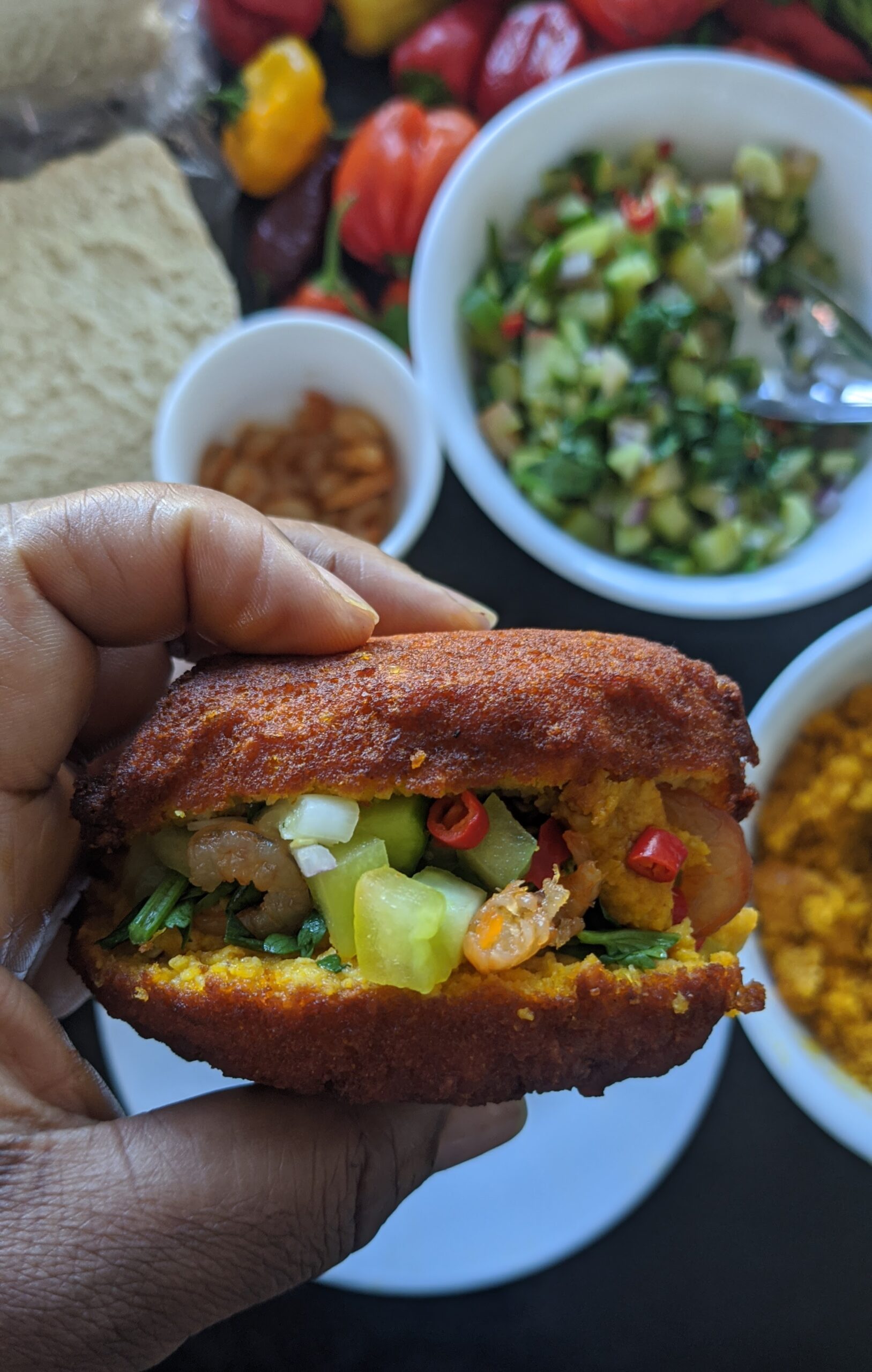
To this day, wherever I am, Nigeria or anywhere else in the world, I have a specific Saturday morning taste memory of bread, ogi and Akara lodged in my head, and heart I daresay. I spent many Saturday mornings as a teenager soaking black-eyed beans till the skins softened, then rubbing them between my palms to strip the creamy halves of their cloaks before turning that into a thick enough puree, seasoned with red onions and scotch bonnet peppers, one with enough integrity to hold it together as it ‘fritters’ in hot oil

Comfort Food
Saturday mornings make me think of home more than any other day of the week. And I’ve been away from home a lot. So what do you do when you’re far away and discover the street food delicacy that’s Nigerian Akara is also Brazilian Acarajé? You feel all the emotions – from kinship to homesickness and saudade – and little of the comfort you desire. Instead, you find yourself deep in reflection as you eat an Akara sandwich, thinking about comfort food and what it means. I love the concept as an anchor of the soul but when I think of my Akara – born free, a dish I make to comfort myself – and put that next to Brazilian Acarajé, borne of the transatlantic slave trade, I wonder if comfort fully captures the range.
Memory as Resistance
Across the world from Brazil to New Orleans, Georgia to the Caribbean, there are edible markers of West African culinary heritage, trails of deliciousness that span multiple ingredients and centuries, from farm or plantation – rice, coffee, pecans, vanilla – to table – calas, gumbo, sweetmeats, bean fritters, myriad cassava dishes and more. Enslaved women, men, and children remembered and transplanted knowledge-systems of wetland farming from the Grain Coast to the American South, birthing Carolina Gold. They folded knowledge into fritters and bakes, sweetened the bitter truth of humanity, and seasoned pots of soups and stews with wisdom. There’s something so powerful about leaving your mark, in spite of, despite it all. And there are wars fought and won over bubbling pots and roaring fires – battlefields of the heart and mind. Yes, there are many treasures gifted by enslaved West Africans, but no war leaves its victims unscathed.

Memory as Freedom
It takes might to transform some type of bitter to sweet, and enslaved West African women did it on the streets. They set up stands and stalls, seats by the side of the road paying homage to their homelands, feeding the masses and purchasing freedom. Today, centuries later, Acarajé remains sacred on the streets of Bahia. Its recipes – initially preserved, treasured and sustained by word of mouth – now live in words and taste buds across the world, proof that food and eating create the strongest memory banks which we draw from, time and time and time again.
And so it is that when yet another Saturday comes by, you might find me, Akara sandwich in hand, fritters deep fried till golden and layered into Canadian Agege bread or challah buns (and on the best days, pieces torn by hand, uncorrupted by the silver of a knife). Is it Agege bread if it isn’t made under the sweltering hot Lagos sun? My taste bank is never confused. My memories draw on snatches of Saturday after Saturday, each contributing to the kaleidoscopic patchwork that’s yet another Saturday: the same yet different, tasting home, old and new.

About
Ozoz Sokoh is a food explorer and geologist. A ‘Traveller by plate’, she believes that ‘Food is more than eating’. Central to her work is the celebration and preservation of Nigerian/West African cuisine, challenging myths and assumptions about its culinary legacy over 400+ years old and its impact on the world from the American South, through the Caribbean to Europe and Latin America.
Her 12-year old blog, Kitchen Butterfly, is her creative space. In 2013, she articulated her philosophy and practice in The New Nigerian Kitchen, focused on celebration and documentation: like the first-ever seasonal produce guide for Nigeria – only one of a handful on the continent. She recently launched Feast Afrique, a platform celebrating West African culinary heritage. One major aspect is a digital library of 240+ books, more than half of which document West African and Diasporic culinary heritage which she’s created as part of this.
Her work has been featured on CNN African Voices and Anthony Bourdain’s Parts Unknown. She makes her home in Ontario, Canada and wakes up to sun-streaked mornings on the couch, good book in hand with a pot of tea. She is a #FutureNewYorker.
For further information, please read our Privacy Policy (updated on June 25, 2018).
By continuing to browse this website, you accept the use of cookies.Close
Коментарі
Дописати коментар